
 Dental Billing
 11-Aug-2026
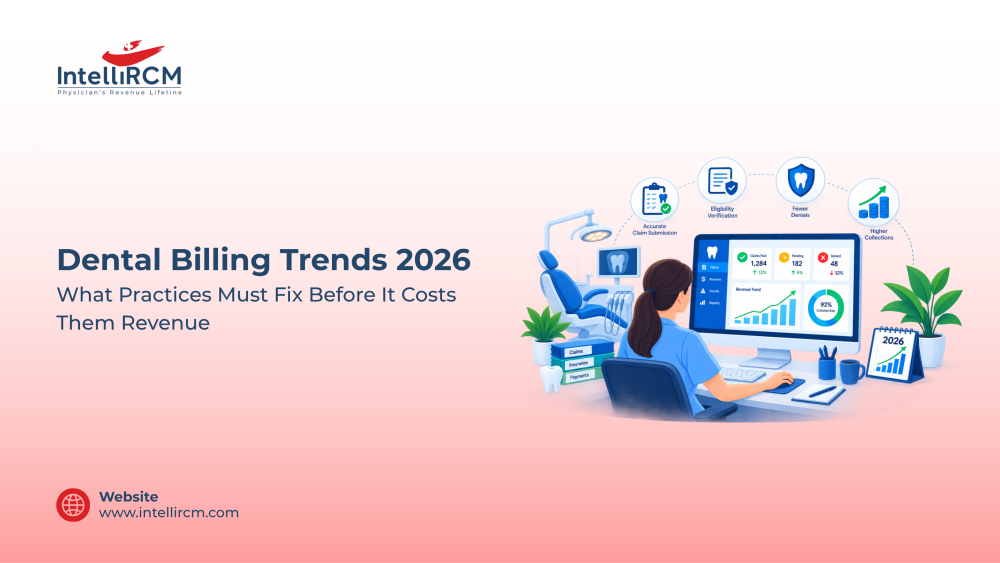
Dental billing in 2026 is not business as usual. Payers are tightening policies, audits are increasing, and practices that fail to adapt are watching revenue leak out through denials, delays, and compliance risk. Nearly one in five dental claims now faces rejection on first submission, with denial rates hovering between 15 and 20% industry-wide (source: Patientdesk.ai). For the average practice, that translates to $50,000 to $120,000 in lost revenue every year (source: Dental AI Assist).
The difference between practices that struggle and those that scale is no longer solely clinical skill. It is a billing strategy. This is your 2026 dental billing playbook - not theory, but the specific changes that protect revenue and keep practices compliant in a stricter, faster-moving payer environment.
Three forces are reshaping dental revenue cycle management right now.
That last point matters more than most practices realize. January 2026 introduced 28 new CDT codes and 12 revisions, and practices still relying on outdated coding saw denial rates spike by 34% in the first quarter alone (source: Dental AI Assist). If your systems are still built for how things worked in 2020, you are already behind.
High-performing practices no longer treat billing as back-office cleanup. They run it like a revenue engine, and that shift starts with structure.
What that looks like in 2026:
This is exactly where a dedicated dental billing specialist earns their keep. Rather than reacting to denials after they pile up, a specialist builds accountability into the front end of the process, catching documentation gaps before a claim ever leaves the office. Practices that pair this with structured revenue cycle management services tend to see denial patterns shrink within a single quarter, not a year.
Medical crossover billing is no longer optional for dentistry. It is a growth strategy, and it starts by tightening core Dental Insurance Billing practices.
Sleep apnea, TMD, oral-systemic connections, trauma, pathology, airway cases, and medically necessary extractions are all areas where practices can bill more accurately and often bill medical insurance in addition to dental insurance. Yet most practices still are not doing it, largely because teams were never trained to think this way.
In 2026, the smartest practices will:
Frequency limitations and shifting definitions of medical necessity, not simple administrative errors, are now the leading drivers of new denials (source: Patientdesk.ai). Getting this discipline right can unlock six-figure revenue for many offices.
Audits are no longer rare. They are routine. Practices must now assume that anything billed could be reviewed, meaning compliance has shifted from a defensive posture to a revenue-protection strategy.
That means:
It also means treating unresolved claims as a compliance issue, not just a cash-flow issue. Practices that lean on structured denial management services catch coding errors and missing documentation before they turn into resubmission cycles or audit flags. Compliance is no longer just about avoiding fines. It is about protecting revenue continuity when scrutiny is the default, not the exception.
The staffing crisis is real, and it is not solving itself. Waiting for the perfect hire is not a strategy.
Winning practices in 2026 will either:
What no longer works is hoping someone learns billing on the job while denial rates and payer scrutiny keep climbing. Even practices with strong clinical production are watching revenue stall in accounts receivable, unpaid claims that patients and payers are both slow to resolve. Practices with a tight handle on accounts receivable management services and a consistent Patient Statement Service tend to collect faster and write off less, because nothing sits unresolved long enough to become uncollectible.
Denials, audits, and staffing gaps will not fix themselves. IntelliRCM helps dental practices tighten billing, protect collections, and stay audit-ready with dental RCM services built for how payers operate today. Get a free billing operations audit and see exactly where your revenue is slipping through.
If you want to future-proof your revenue, your 2026 plan should include:
Practices that treat this as a one-time fix tend to revert to old habits within a few months. The practices that hold their gains are the ones that build these checks into a recurring cycle.
This is exactly why practices are turning to IntelliRCM. As a dedicated provider of dental RCM services, IntelliRCM was built around the exact shifts reshaping the industry in 2026: tighter payer scrutiny, growing medical-dental crossover opportunity, and a compliance bar that keeps rising.
IntelliRCM brings together the full picture, not just one piece of it, by combining accurate coding, proactive denial follow-up, medical necessity documentation support, and clear patient billing communication under one roof. For practices weighing whether to build an in-house team or outsource dental billing altogether, IntelliRCM offers dental billing solutions that flex to either model, giving practices expert-level billing support without the overhead of building a full department from scratch.
The result is a billing operation that behaves like a revenue engine, not admin work sitting in the background waiting to be dealt with.
Struggling with claim denials and slow payments? Learn 10 expert dental billing tips to reduce denials, speed up collections, and boost practice revenue. Get started today.
Read Full GuideDental billing in 2026 rewards practices that treat it as a strategic function, not a task delegated to whoever has time. Payers are scrutinizing claims more closely, audits are more frequent, and staffing gaps are not closing on their own. Practices that adapt now, by tightening documentation, building real medical crossover discipline, treating compliance as revenue protection, and getting the right people or partners in place, will be the ones still collecting what they earn a year from now.
The practices that wait are the ones that will continue to absorb denials as a cost of doing business. The ones that act are the ones building a billing system that actually works in 2026, not 2020.
The CAQH Network plays a vital role in improving the efficiency and accuracy of provider enrollment and credentialing. By leveraging the capabilities of the CAQH Network and integrating it effectively into their RCM processes, healthcare providers can streamline operations, reduce administrative burden, and improve access to care. As the healthcare industry continues to evolve, the CAQH Network will remain an essential tool for navigating the complexities of provider enrollment and credentialing.
Read More
Track DSO, CEI, ADD, AR Turnover, and Aging to boost collections. Improve your revenue cycle management services with IntelliRCM. Get expert help today.
Read More
Optimize medical billing, reduce denials, and improve cash flow with proven RCM strategies. Learn key steps to strengthen your revenue cycle performance.
Read More