

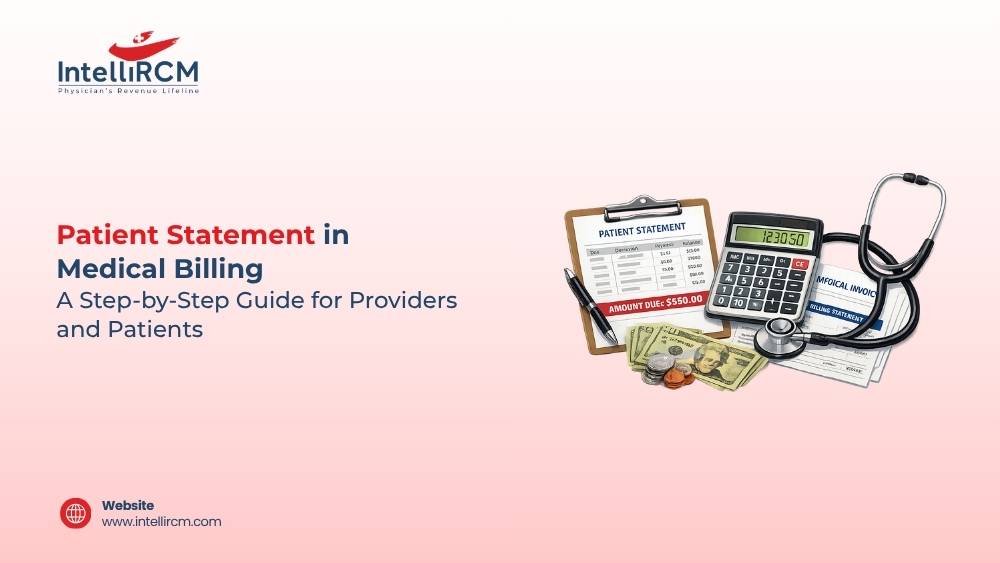
 Patient Statement
 24-Jun-2026
Picture this: a patient walks out of a clinic feeling relieved after a successful visit. A few weeks later, a document arrives in their mailbox. It lists services, numbers, and an amount due. Most patients stare at it with more questions than answers.
That document is a patient statement, and how well it communicates can determine whether your practice gets paid on time or chases that balance for months.
A patient statement in medical billing is not simply a bill. It is the final financial communication between a healthcare provider and a patient, one that carries the weight of the entire billing cycle on its shoulders. When it is done right, it builds trust, speeds up collections, and reduces friction. When it is done poorly, it creates confusion, disputes, and delayed revenue.
This guide breaks down everything providers and billing teams need to know about patient statements, from what they are to how they work and why they matter deeply to your practice's financial health.
A patient statement in medical billing is an official financial document sent by a healthcare provider to a patient. It outlines the services rendered, the charges applied, the amount covered by insurance, and the remaining balance the patient is responsible for paying.
Before this document ever reaches the patient, a structured process has already taken place. The provider submits a claim to the insurance payer. The payer processes it, applies the patient's benefits, and pays its portion. What remains after deductibles, co-payments, and coinsurance is then calculated and communicated to the patient through this statement.
In straightforward terms, a patient statement answers five essential questions:
Statements are delivered through multiple channels today, including traditional mail, email, and online patient portals. The delivery method matters less than the clarity of the content. A well-prepared statement creates full financial transparency and sets the right expectations from the very first read.
Patient statement generation typically occurs after payment posting, making it one of the last steps in the revenue cycle. However, its impact on collections and patient satisfaction is anything but minor.
From a practice's perspective, patient balances represent a significant and growing portion of total revenue. With the rise of high-deductible health plans, patients are now responsible for a larger share of their healthcare costs than ever before. Nearly 60% of privately insured adults are enrolled in high-deductible health plans as of recent years (Source: Kaiser Family Foundation, 2023). This shift makes timely and accurate patient statement generation not a courtesy, but a financial necessity.
Practices that delay statements or send confusing ones face slower collections, higher accounts receivable aging, and greater write-off rates. A clean, prompt, and professional patient statement directly supports the bottom line.
Patients are not billing professionals. When they receive a document filled with procedure codes, adjustment lines, and unexplained balances, the most common response is to set it aside. Confusion breeds delay.
On the other hand, patients who receive a clear, plain-language statement understand what they owe and why. That understanding is the single most reliable driver of timely payment. Patients are far more likely to pay quickly when they trust the document in front of them.
Patient statements must meet defined standards of accuracy and transparency to remain compliant with HIPAA and federal billing regulations. Errors on a patient statement, whether in the balance calculation, the patient's personal information, or the service descriptions, do not just slow down collections. They create legal and regulatory exposure for the practice.
Compliant patient statement services ensure that every document sent to a patient reflects verified data, accurate adjustments, and language that meets regulatory expectations.
A professionally designed patient statement delivers more than a payment request. It produces five measurable outcomes for the practice:
Think of the revenue cycle as a relay race. Front-end eligibility verification sets the patient's financial expectations early. Accurate coding ensures the claim reflects the services provided. Clean claim submission gets the insurer to process quickly. Payment posting records what was received. And then the patient statement picks up the final leg and carries it to the finish line.
This is where revenue cycle management services connect directly to patient statement outcomes. Any error introduced earlier in the cycle- an incorrect address, a miscommunicated copay estimate, a partially denied claim left unexplained- surfaces in the patient statement. And at that point, the patient has no context for what went wrong upstream.
Patient statements serve three specific roles within the revenue cycle:
Practices that treat patient statements as a strategic revenue cycle asset, rather than a routine billing task, consistently see better collection rates and fewer patient disputes.
Unclear patient statements lead to confusion, disputes, and slower collections. IntelliRCM delivers accurate, compliant, and patient-friendly statement generation that gets you paid faster. Let us handle the final mile of your revenue cycle – the right way.
Every effective patient statement shares a common structure. When any of these components is missing or unclear, the patient's ability to understand and act on their balance is compromised.
Full name, date of birth, account number, and date of service are the foundation of every statement. These details allow patients to match the statement to their own records and to the Explanation of Benefits (EOB) they received from their insurer.
The statement must clearly identify who is billing the patient. Practice name, billing address, and contact information are essential. When patients receive a statement from an unfamiliar name or address, their first instinct is to question its legitimacy. Clear provider identification is the first trust signal a statement sends.
This section lists the dates of service, the procedures performed, and the associated charges. Plain-language descriptions matter enormously here. A line that reads "D2740 - $1,200" tells a patient almost nothing. A line that reads "Porcelain Crown - $1,200" tells them exactly what they paid for. Wherever possible, procedure codes should be accompanied by plain descriptions that a non-medical reader can understand immediately.
Patients need to see what their insurance paid and why the remaining balance is what it is. Transparent adjustment lines that explain contractual write-offs or plan discounts significantly reduce confusion. When patients can see that the full charge was reduced before their portion was calculated, they are far less likely to dispute the balance.
The total amount owed must appear prominently and without ambiguity. Burying this figure in dense text or making it visually difficult to locate is one of the fastest ways to slow down payment. The balance due should be the most visually accessible number on the entire document.
Patients should never have to wonder how to pay. The statement must provide clear, working pathways, whether online through a portal, by check through the mail, or in person at the front desk. The more accessible the payment process, the faster the balance gets resolved. This is a core element of any reliable patient statement service.
A statement without a due date is easily treated as optional. A clearly stated, reasonable due date creates accountability and signals that the practice expects timely resolution. This single element has a measurable impact on how quickly patients act.
IntelliRCM brings over a decade of specialized expertise in healthcare billing to every aspect of patient statement generation. From accurate demographic capture to compliant, plain-language statement design, IntelliRCM ensures that every patient statement your practice sends is clear, timely, and built to collect.
Beyond patient statements, IntelliRCM supports the full financial lifecycle of your practice. Whether you need denial management services to recover lost revenue, accounts receivable management services to reduce aging balances, or a fully integrated medical revenue cycle management solution, IntelliRCM provides the infrastructure and expertise to keep your revenue cycle performing at its highest level.
Practices partnering with IntelliRCM benefit from streamlined workflows, reduced billing errors, faster payment turnaround, and a patient communication experience that builds trust from the first statement to the final payment.
If your current patient statements are generating confusion, delays, or disputes, IntelliRCM is ready to help you turn that around.
Learn how 2026 CMS billing rules affect your practice and protect your revenue with proven medical billing solutions. Contact IntelliRCM today to start saving.
Read Full GuideThe patient statement in medical billing is the last mile of a long financial journey. Everything that came before i-, eligibility verification, claim submission, insurance adjudication, payment posting- all of it leads here. And how this final document is written, designed, and delivered determines whether that journey ends in payment or prolonged collection efforts.
A well-executed patient statement is clear, accurate, timely, and easy to act on. It respects the patient's time and intelligence while protecting the practice's revenue. The variables that make it successful- language, layout, delivery speed, follow-up, and payment flexibility- are all within the practice's control.
The opportunity to improve is always available. And the return on that improvement, measured in faster collections, fewer disputes, and stronger patient relationships, is one of the most accessible wins in the entire revenue cycle.

Learn how end to end revenue cycle management improves healthcare cash flow, reduces claim denials, and streamlines billing. Read the blog to strengthen your RCM
Read More
AI-driven dental billing is cutting claim denials by up to 50% in 2026. Learn how smart dental revenue cycle management, expert billing specialists, and outsourcing can maximize your revenue.
Read More
Virtual assistant technology has the potential to revolutionize patient engagement in healthcare, improving access to care, enhancing patient satisfaction, and ultimately driving better health outcomes. By embracing these innovative technologies and addressing the associated challenges, healthcare providers can unlock the full potential of virtual assistants to transform the patient experience and improve the quality of care.
Read More